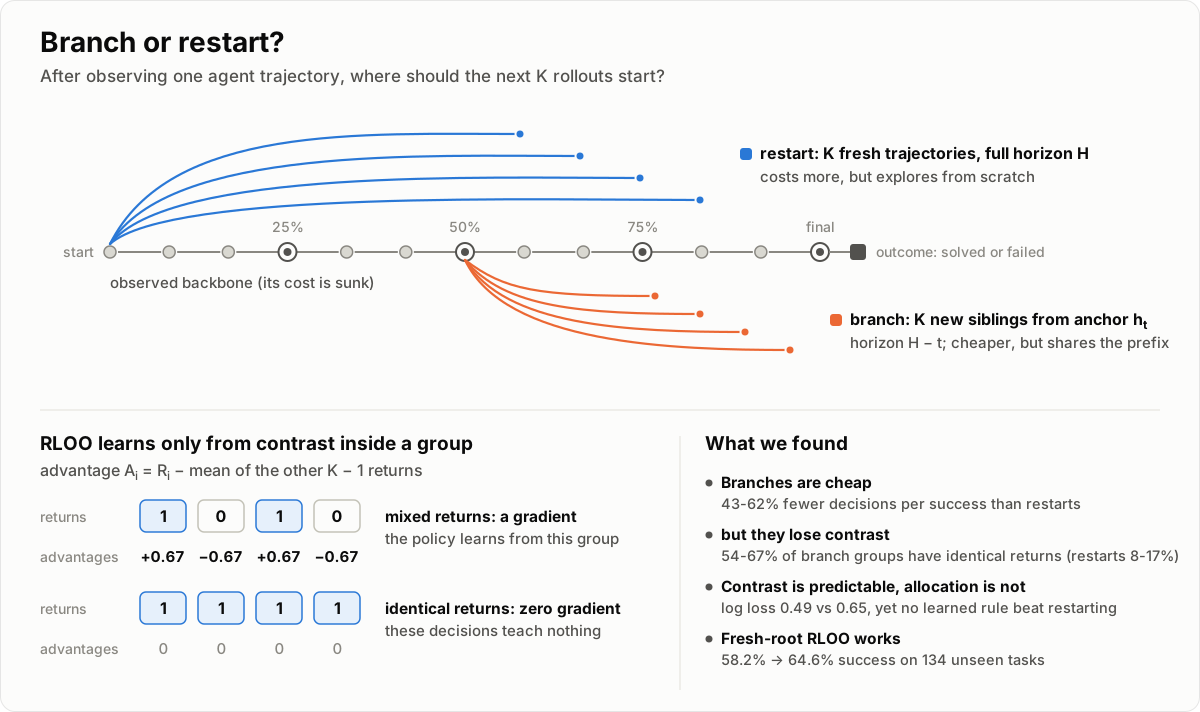
The question. On-policy RL for LLM agents spends most of its compute generating rollouts. Once one trajectory has been observed, the next batch can start from the beginning (a restart) or continue from a state part-way along it (a branch). Branching skips the prefix, so the same budget buys more samples. Is it the better buy?
What I found
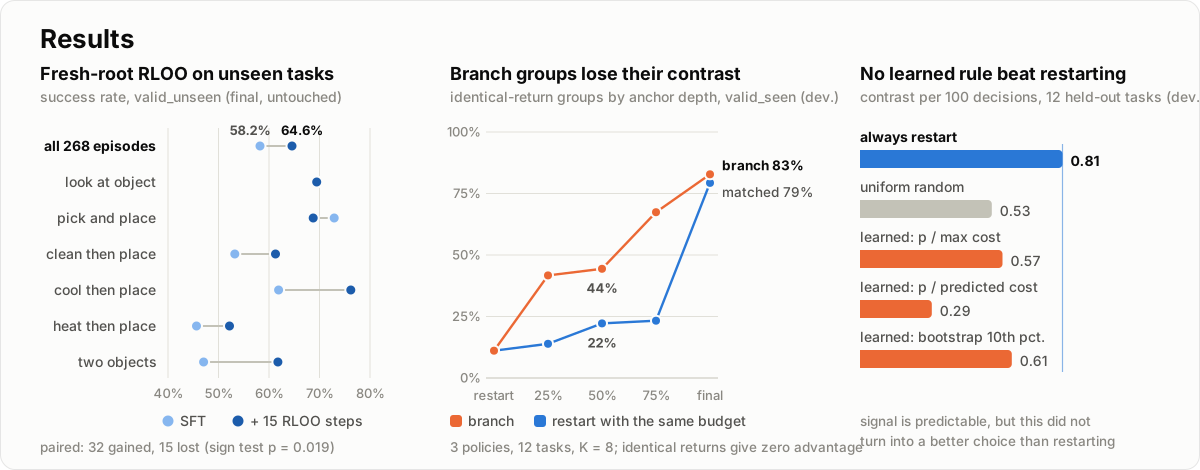
- Fresh-root RLOO works. Qwen3-1.7B on text ALFWorld goes from 58.2% to 64.6% success across 268 episodes of a split held untouched until the end: 32 episodes gained, 15 lost, exact sign test p = 0.019.
- Branches are cheap. 14–17 decisions per continuation against 33–38, which is 43–62% fewer decisions per success.
- And they teach almost nothing. 54–67% of branch groups return identical rewards, against 8–17% of restart groups. RLOO scores each trajectory against the others in its group, so identical returns are exactly zero gradient.
- That collapse is the shared prefix, not the shorter horizon. Against restarts capped at the same remaining budget it is still 42–67% versus 14–23%. In 29–46% of branch groups all eight siblings even chose the same first action, against at most 8% of restart groups.
- Predictable, but not exploitable. A seven-feature model predicts which groups will have contrast (held-out log loss 0.491 against 0.650 for the base rate), yet no allocation rule built on it beat always restarting (0.81 against 0.61 contrast per 100 decisions). No branch allocator is claimed.
How it is built
- Policy. Qwen3-1.7B with LoRA on every attention and MLP projection (17.4M trainable, 1.0%). A supervised warm start on 512 expert walkthroughs, then 15 steps of fresh-root RLOO: K = 4 per task, leave-one-out advantages, one AdamW step per batch, no KL term.
- Exact branching. Any decision state can be checkpointed and restored by deterministic replay, checked against a SHA-256 signature over observation, score, admissible commands and PDDL facts. The facts matter: a microwave you opened and walked away from reads identically in text to one you never opened. A continuation’s rebuilt prompt must match the original token for token, or it raises.
- Controls that isolate the cause. Branch groups are measured against two restart controls, full horizon and capped at the same remaining budget, which separates where a rollout starts from how many decisions it has left.
- Reproducibility. Per-decision sampling seeds from a BLAKE2b hash, so any rollout replays independently of process history; token-level provenance on every decision; gradients recomputed by the model being trained rather than reusing sampling log-probabilities. About 4,000 lines with unit and integration tests, and every run fits on one 24 GB RTX 3090.
What this does not claim
That branching improves learning, or that any learned allocator beats restarting. This is one model, one environment and a single 15-step run at one seed. An exploratory probe was cut from the conclusions after an audit showed a fresh Adam optimizer’s first step moves every coordinate by the same amount regardless of gradient magnitude, which made its ordering meaningless.