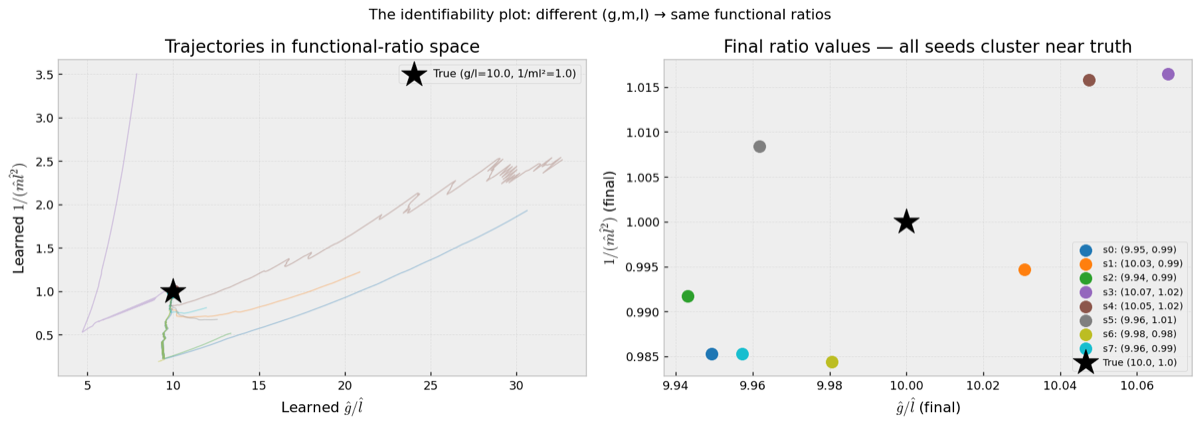
Question. Differentiable MPC learns a controller’s dynamics by back-propagating an imitation loss through the iLQR solver. When the learner matches the expert’s actions, has it actually learned the true dynamics?
Setup. An expert MPC with true pendulum parameters (g = 10, m = 1, l = 1) generates action sequences from random initial states. A learner with the same cost starts from random (ĝ, m̂, l̂) and minimizes ‖u* − û‖² through the differentiable solver (8 seeds, 10 expert trajectories, horizon 20, 2,000 iterations), built on mpc.pytorch.
Result.
- Every seed imitates the expert almost perfectly: imitation loss 2.8e-4 to 7.6e-4.
- Every seed recovers the two quantities the dynamics actually depend on (g/l ∈ [9.94, 10.07] and 1/(ml²) ∈ [0.984, 1.017]), while the individual parameters do not converge: g ranges from 7.1 to 17.0 and m from 0.34 to 2.0.
- With wider, unrestricted initialization, 7 of 8 seeds still converge; one diverges (loss 6.7, g/l = 31).
Takeaway. The pendulum dynamics θ̈ = (3g / 2l) sin θ + 3u / (ml²) are invariant along a manifold of (g, m, l); imitation data can only pin down g/l and 1/(ml²). Parameter MSE, which the paper reports as “model loss”, therefore penalizes an unobservable direction; imitation loss, or error in the identifiable ratios, is the right yardstick. The same question, what a learned model must get right to be useful for control, is central to world models for robotics.