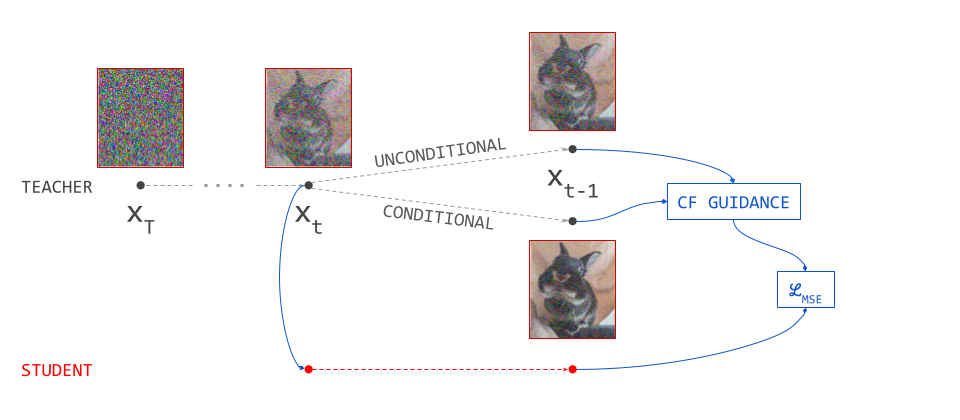
The goal. Stable Diffusion needs tens of denoising steps per image, and those steps dominate latency. Following Flash Diffusion, I distilled the model into a small LoRA student that samples in a handful of steps, and built a harness to measure what that speed costs.
Method
- Teacher. The frozen SD 1.5 UNet runs several DDIM steps from a noisy latent, with classifier-free guidance (scale 7.5).
- Student. The same UNet with LoRA adapters (rank 4, α = 32) on the attention projections, about 4M trainable parameters. It learns to reach the teacher’s multi-step target in a single forward pass, without guidance, under an MSE loss.
- Schedule. Training timesteps are drawn from the few-step inference schedule, LCM-style, to reduce the mismatch between training and sampling.
- Training. COCO (118K image-caption pairs) on one RTX 4000 Ada (20 GB), mixed-precision FP16 with Accelerate, with checkpoint and resume.
Benchmark harness
Each configuration generates 20 prompts × 10 images, with CUDA-synchronized timing, CLIP ViT-B/32 text-image alignment, side-by-side grids against the baseline, and CSV and JSON reports.
Results
| Sampling | Time per image | Speed-up |
|---|---|---|
| SD 1.5, 50 steps with guidance | 2.17 s | 1.0× |
| LoRA student, 8 steps | 0.25 s | 8.7× |
| LoRA student, 4 steps | 0.16 s | 13.6× |
| LoRA student, 2 steps | 0.12 s | 18.1× |
Sub-second generation at every setting, on a single 20 GB GPU.