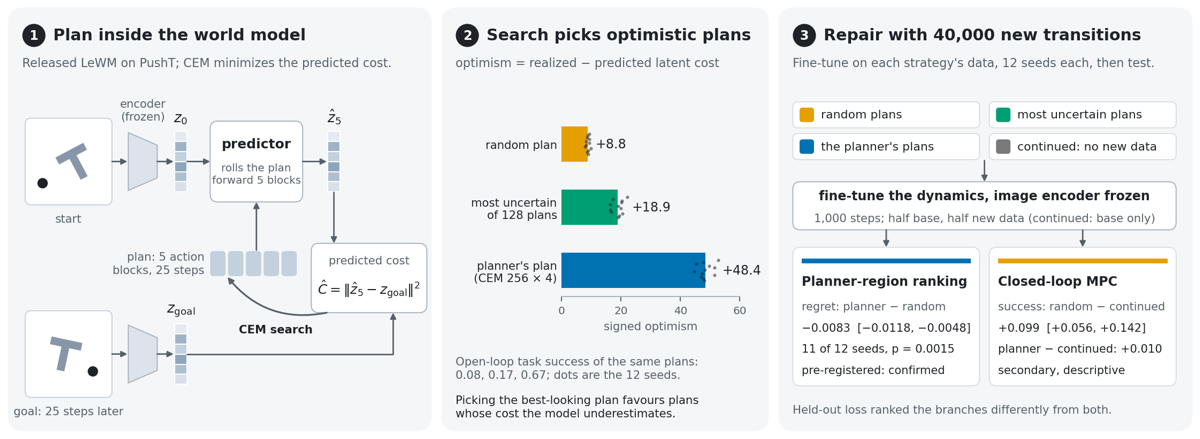
The question. A planner searching through a learned world model does not sample that model’s errors uniformly. It hunts for plans the model is optimistic about, so the errors that matter are exactly the ones search finds. Is the planner’s own experience then the best data for repairing the model?
What I found
- Search selects optimistic errors, and more search selects them harder. The plan CEM picks is far more over-optimistic than a typical proposal, and the gap grows with search pressure: selection amplification rises from 10.6 to 51.1 between 128×1 and 512×6 samples. The planner’s chosen plans carry 2.6× the rollout error of random plans, while succeeding far more often (open-loop success 0.67 against 0.08).
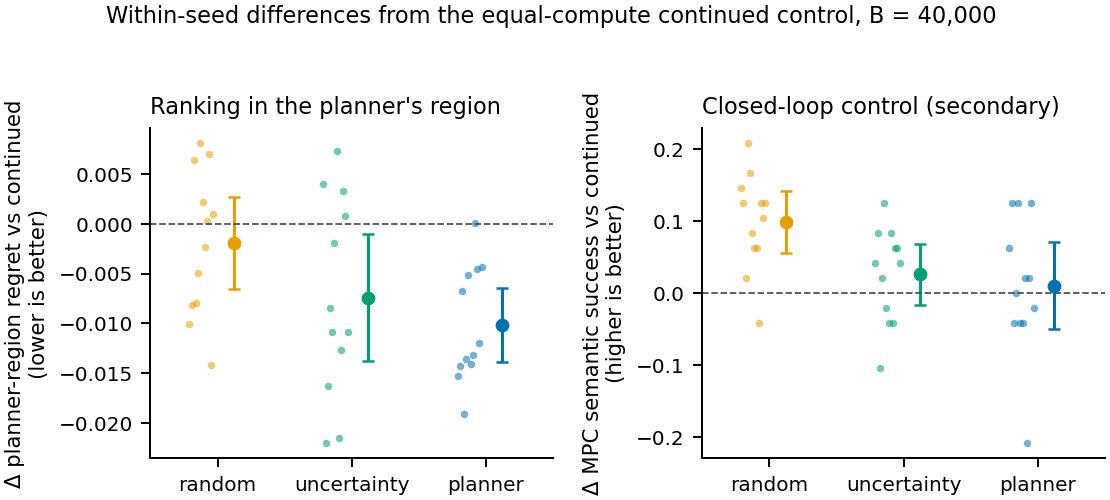
- Planner data repairs the planner’s own ranking (pre-registered, confirmed). Fine-tuning on planner-selected transitions cut top-choice regret on the planner’s candidate pool by 14% against random data: −0.0083 [−0.0118, −0.0048], 11 of 12 seeds, exact sign-flip p = 0.0015, dz = −1.50.
- “Better model” depended on the use. Against an equal-compute control, planner data improved ranking (−0.0102) but left closed-loop MPC flat (+0.010). Random data did the reverse: MPC +0.099 [+0.056, +0.142], ranking unchanged.
- Held-out loss tracked neither. The branch with the best held-out prediction loss ranked the planner’s candidates worst. The usual model-quality number was not the one that mattered downstream.
- Two follow-ups were closed at their gates, and are reported in full. A pre-registered optimization-depth study returned NO-GO (latent regret rose in 28 of 48 cases where 34 were needed, and no faster than an exchangeable-error null). A planner-conditioning study was closed on its validity gates before any outcome was seen, because the two planners’ candidate sets overlapped too much to compare.
How it is built
- Task and model. PushT block-pushing with the released LeWM latent world model: a frozen ViT-tiny image encoder, a 192-d latent and a 6-layer transformer predictor, with only the dynamics fine-tuned. CEM and random shooting plan over 5 action blocks, scored by predicted latent distance to the goal.
- Equal budgets and a real control. Each of the three acquisition strategies (random, ensemble-uncertainty, planner) gets the same 40,000 transitions and the same 1,000 training steps, alongside a continued-training control that gets the compute but no new data. That separates more training from which data.
- Pre-registration. Hypothesis, primary metric, seeds, analysis and stopping rule were fixed before any confirmatory model was trained; the one amendment is published with its reason, and the analysis that broke the stopping rule is labelled exploratory.
- Inference. The seed is the unit (n = 12), with exact two-sided sign-flip permutation tests, 95% intervals and effect sizes. Candidate pools are executed once and shared, so every model ranks identical plans against identical outcomes.
- Scale and provenance. 49 evaluated models × 48 held-out cases = 2,352 result rows; every row records the commit, protocol digest, manifest and checkpoint. About 4 GPU-hours on one RTX 3090.
Scope and limits
The confirmed claim is matched-planner: the repair data and the evaluation pool come from the same CEM configuration. The wider checks are not significant, and are reported as such (q0 pool p = 0.11; each model’s own higher-pressure plan p = 0.25). Planner against uncertainty is unresolved on the primary metric. One environment, one budget, one model family; the closed-loop results are secondary and the replay-weight analysis is exploratory.