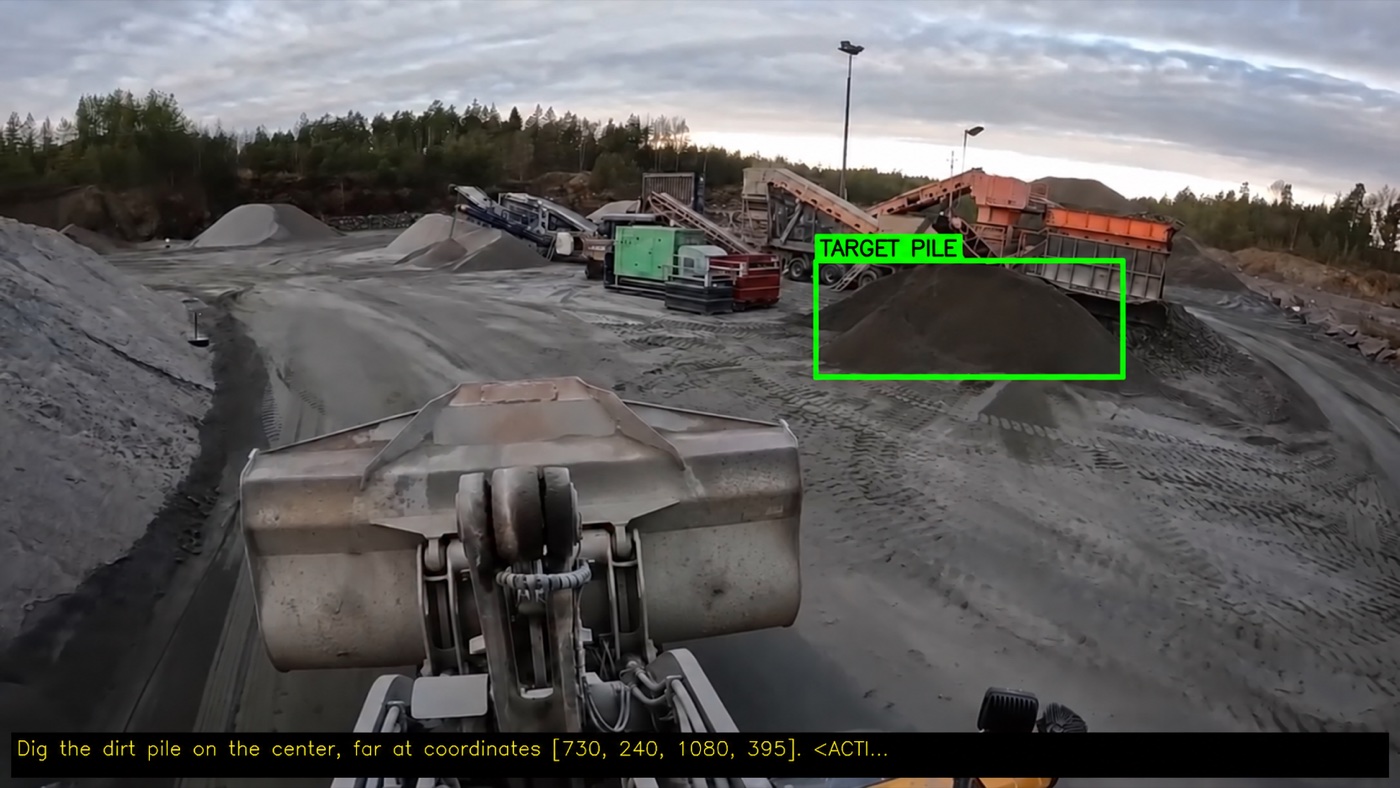
The problem. An autonomous wheel loader has to decide where to dig from its forward camera. General-purpose vision-language models can describe a quarry, but they do not return a grounded target that a controller can act on.
Approach
- Data engine. Frames are sampled from operator videos and labelled automatically with Florence-2-large-ft (phrase grounding, captioning and VQA), giving 848 LLaVA-style conversations. Each answer carries the target box
[x1, y1, x2, y2], its position (left, center or right; ahead or far) and an action tag such as<ACTION_APPROACH>. - Model. Qwen3-VL-2B-Instruct fine-tuned with LoRA (rank 16, α = 32) on a 4-bit NF4 base: 17M trainable parameters, 0.8% of the model. Two epochs, effective batch size 16, learning rate 2e-4, FP16 with gradient checkpointing.
- Footprint. Training fits in about 10 GB of GPU memory and inference in about 6 GB, so the whole pipeline runs on one consumer GPU.
What it does
Asked “Where should I dig?”, the model returns a target box, a spatial instruction and a discrete action (figure above), learned from under a thousand automatically labelled frames.
Limitations and next steps
- Single-frame reasoning, with no temporal context and no depth.
- Labels inherit Florence-2’s errors, and the footage has geographic and weather bias (no snow).
- Next: multi-frame input, depth or LiDAR, and closing the loop with a controller so that guidance becomes action.